Filter Basics
Simple answers about filter efficiency, particle size, MERV ratings, and choosing the right filter for your system.
Learn What Matters To You
Choose a topic below. Each section gives you the basics first, with links to related information if you want to dig deeper.

What's Floating In Your Air?
See how common household particles compare in size - and just how small the particles moving through your home can be.
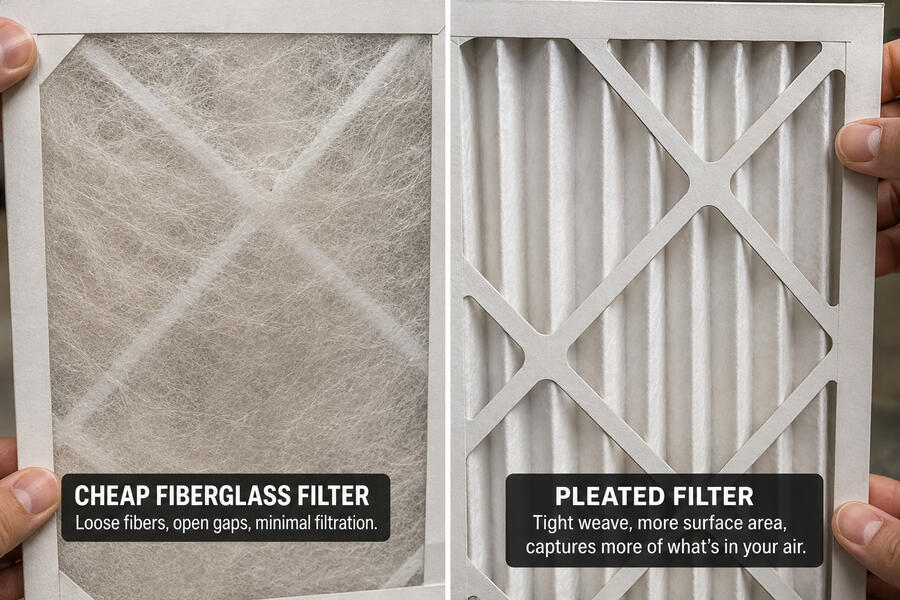
Fiberglass vs. Pleated
See why basic fiberglass provides very limited airborne particle filtration compared with pleated filters.
How MERV Ratings Work
Learn how filters are tested across different particle sizes, what the MERV number really means, and why higher ratings capture smaller particles more effectively.
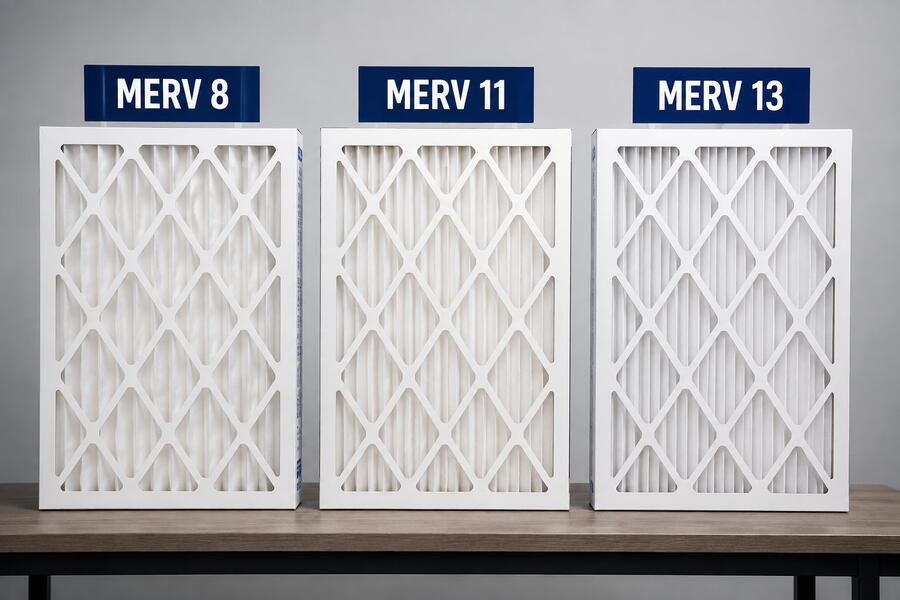
Which MERV Should I Use
Compare MERV 8, 11, & 13 to learn which level of filtration makes sense for your home or business HVAC system.
What's Floating in Your Air?
Your HVAC filter has two jobs: help protect the equipment and remove particles from the air moving through your home. The smaller the particle, the more important filter efficiency becomes.
What to Look For
The farther you move toward the smaller particle sizes, the harder those particles are to see—and the more important filter efficiency becomes. Use the chart to compare familiar household particles with the sizes your HVAC filter is being asked to capture.
Start With What You Recognize
Dust, pollen, hair, and other familiar material help put micron sizes into perspective.
Notice How Small It Gets
Much of what circulates through your HVAC system is far smaller than the visible dust you see around the house.
Look Below 10 Microns
These smaller particles can remain suspended in the air and continue circulating through the HVAC system instead of quickly settling out.
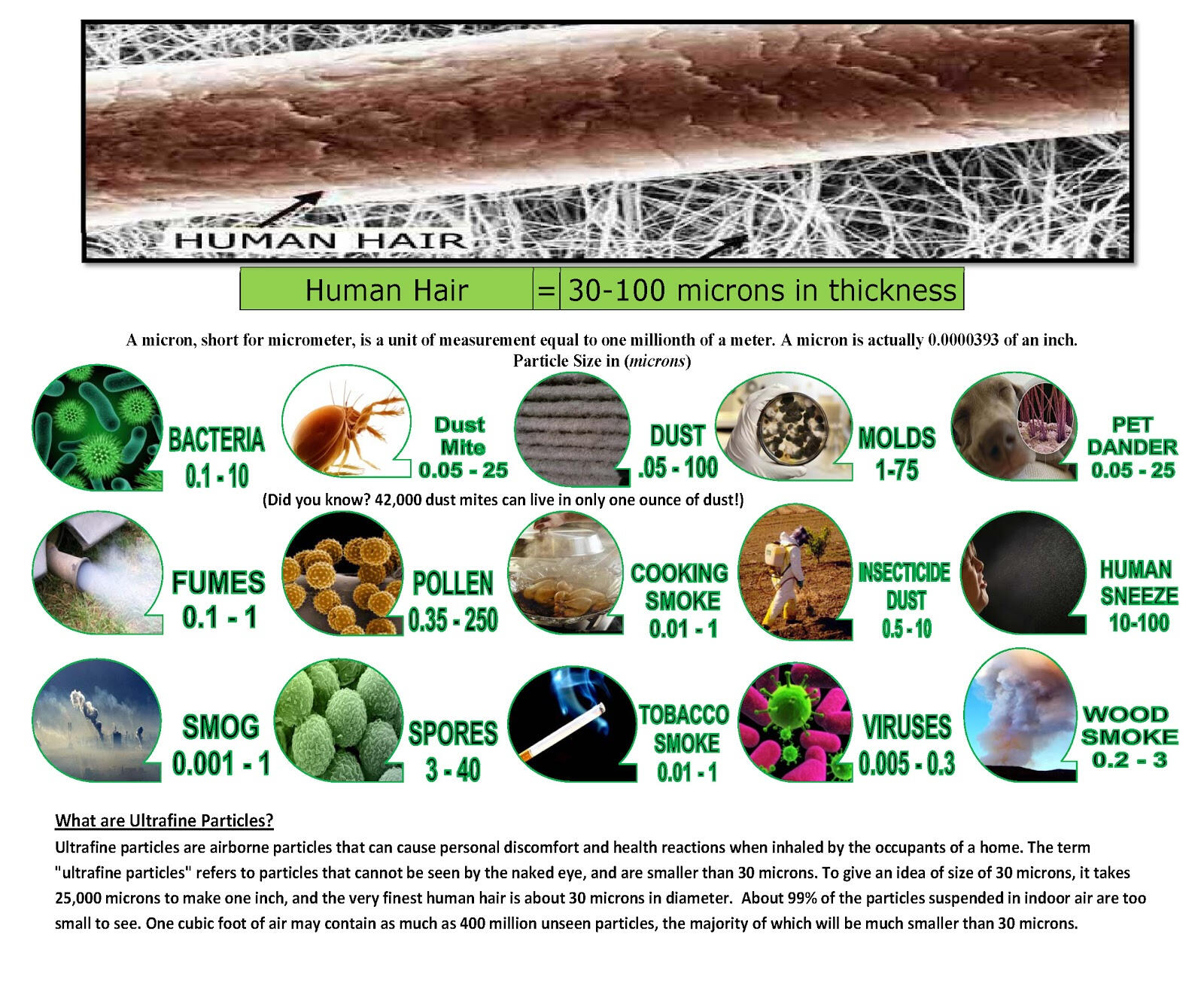
These size comparisons help show why visible dust is only part of what an HVAC filter encounters.
Protect Your HVAC System
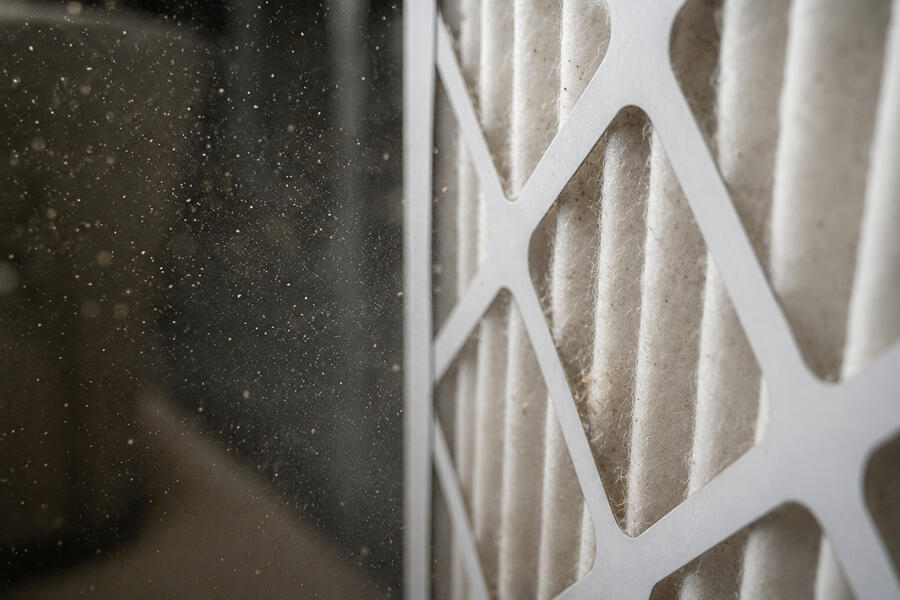
Your evaporator coil already operates in a dark, damp environment. Fine particulate that passes through the filter can stick to the wet coil and build up between the fins. That buildup can reduce airflow and insulate the coil, making heat transfer less efficient.
Keeping fine particulate off the coil is one of the filter’s most important jobs.
Improve the Air You Live In
Particles that pass through the filter can continue circulating through your home. Better filtration removes more of that particulate each time the air moves through your HVAC system.
Fiberglass vs. Pleated
They may fit the same filter slot, but they don’t do the same job.
Fiberglass
• Very open media with limited surface area• Primarily captures larger debris• Limited capture of smaller airborne particulate• Often chosen simply because it has the lowest upfront cost• Frequently replaced monthly, even though loading can increase particle-capture efficiency• Low initial resistance comes from very open media that allows more fine particulate downstream.• Can allow fine particulate to reach the evaporator coil and blower• Provides little flexibility in filtration efficiency
Pleated
• Much greater media surface area• Captures a broader range of particle sizes• Available in different filtration efficiencies• Designed to provide filtration while maintaining required system airflow• Initial resistance is part of the HVAC system’s overall airflow/static-pressure relationship• Helps reduce particulate reaching the evaporator coil and blower• Can be selected to match both filtration goals and system capability• Pleating adds surface area for better particle capture vs. overly flat media.
The goal isn’t maximum airflow. It’s the airflow the equipment was designed to operate with, while still providing meaningful filtration.
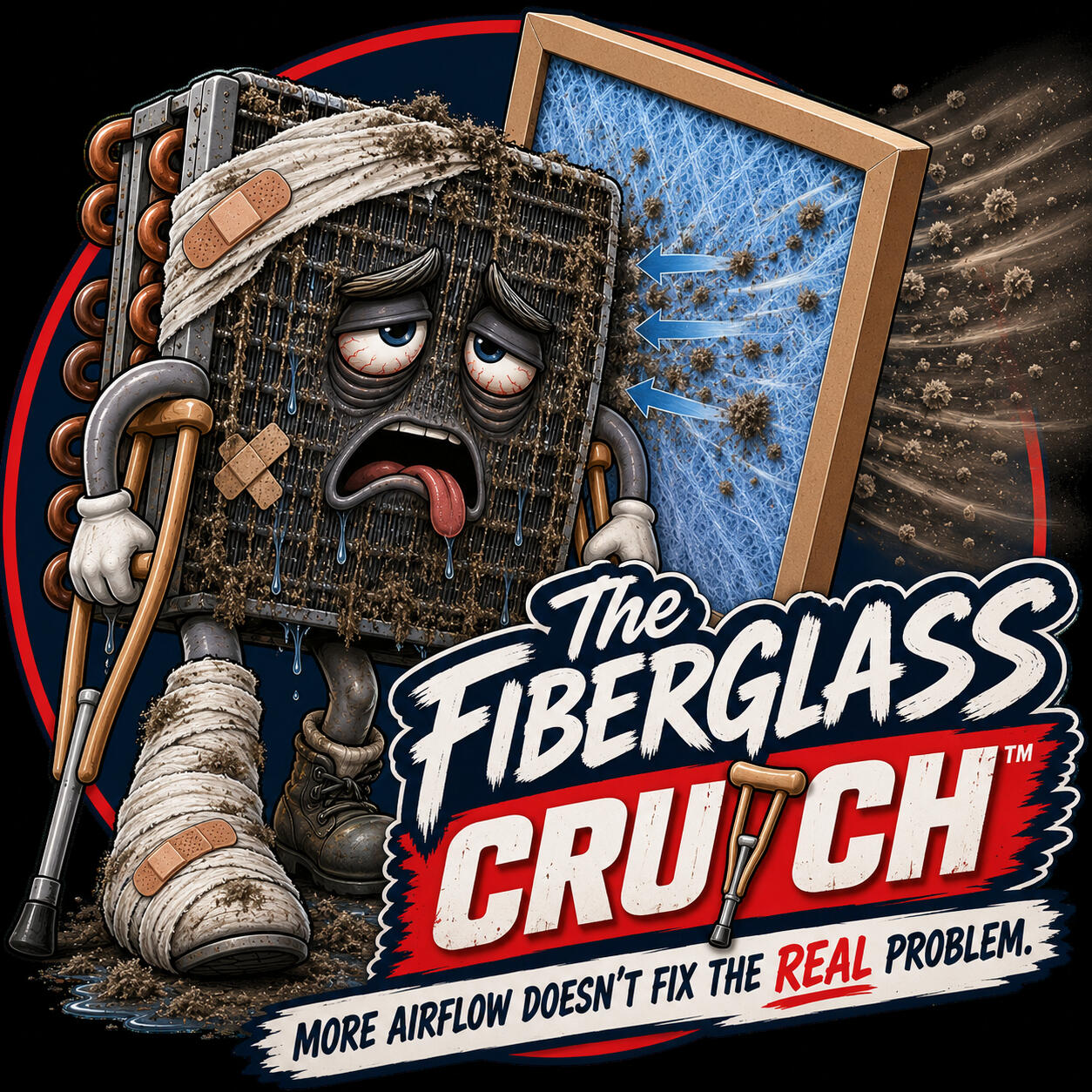
The Fiberglass Crutch™
Why “more airflow” can hide the real problem.
The advice to use fiberglass because “it lets the system breathe” has been around for generations. There was some logic behind it: older higher-efficiency filters often created more resistance than modern pleated designs. Filter technology has changed, but the advice has stuck.
A very open fiberglass filter can also make an HVAC system with an existing airflow problem appear to perform better. If the return air system is undersized, the coil is already dirty, the ductwork is restrictive, or static pressure is already too high, removing most of the filter resistance may increase airflow.
But that doesn’t fix the problem. It uses fiberglass as a crutch for an airflow problem somewhere else in the system.
There’s another problem with that approach: the fine particulate fiberglass allows through has a perfect place to collect—the evaporator coil. During cooling, the coil is wet, so dust can cling to the surface and build up between the fins. Over time, that can reduce airflow and heat-transfer efficiency.
Modern pleated filters use substantially more media surface area to capture smaller particulate while providing the airflow a properly functioning HVAC system needs.
The goal isn’t the least possible resistance. It’s proper airflow, effective filtration, and a clean HVAC system.
Important: Some HVAC systems genuinely require very low-resistance filtration. The Fiberglass Crutch™ is using fiberglass by habit—not because the system actually requires it.
How MERV Ratings Work
MERV is not simply a “higher number = better filter” scale. It measures how effectively a filter captures particles across different size ranges.
Need a refresher on how small these particles are?
The smaller the particle, the harder it is to capture.
MERV ratings are based on ANSI/ASHRAE Standard 52.2-2025, which evaluates filter performance across particle sizes from 0.3 to 10 microns.
E1
0.3 to 1 Micron
The smallest particles measured in the MERV test. These are the most difficult for typical HVAC filters to capture effectively.
E2
1 to 3 microns
Includes smaller airborne particulate that can remain suspended and circulate through the HVAC system for extended periods.
E3
3 to 10 microns
Larger particles such as many types of dust and pollen. These are generally easier for filters to capture than the smaller E1 and E2 particles.
What this means for everyday filtration
MERV 8 is where filtration begins to become much more meaningful in the 3–10 micron range. MERV 11 improves capture into the 1–3 micron range, while MERV 13 reaches further into the smallest particles measured by the MERV test.
That’s why MERV 8 is a sensible baseline—not the finish line.
A filter earns its MERV rating based on how it performs across these particle-size ranges—not simply how much material it appears to stop.
Why this matters
Two filters can look similar and still perform very differently. The MERV rating gives us a standardized way to compare how well they capture particles of different sizes.
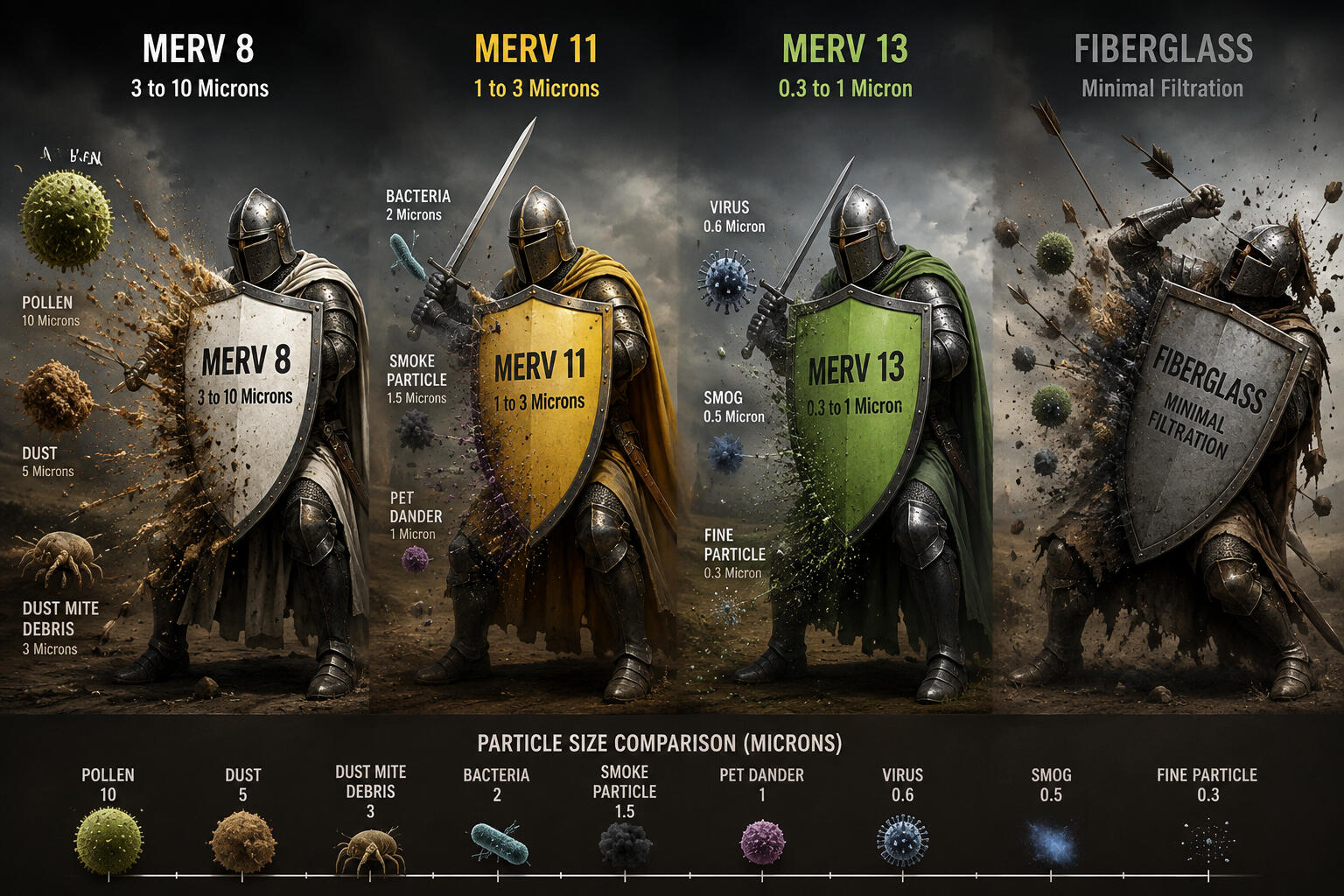
Which MERV Should I Use?
There isn’t one MERV rating that is right for every home. The right MERV rating depends on how much filtration you want and what your HVAC system is designed to handle.
For many homes, MERV 8 is a practical baseline. MERV 11 and 13 are useful step-ups when pets, allergies, smoke, or other conditions call for more filtration—as long as the HVAC system can maintain its required airflow.
What’s Creating Particles in Your Home?
Choose the situations that sound familiar. Each one points to the level of filtration that may make sense for your space.




Everyday Dust
Normal daily life creates plenty for your HVAC filter to deal with.

Shoes, open doors, bedding, clothing, and everyday activity continually bring dust and debris into the home.
Recommended starting point: MERV 8
Pets
Pets can significantly increase the amount of material your HVAC filter has to capture.

Dogs and cats bring in outdoor dirt, shed hair, and add skin flakes and other debris to the air and surfaces around the home.
Recommended step up: MERV 11
Allergies
Allergy-prone homes benefit from capturing more of the smaller airborne irritants that stay suspended longer.

Pollen, mold, dust, and other common triggers can circulate through the home instead of settling quickly. Stepping up filtration can help remove more of those particles each time the air passes through the HVAC system.
Recommended step up: MERV 11
For stronger particle capture: MERV 13, if the system can support it
Smoke & Fine Particles
Smoke creates much smaller airborne particles than ordinary household dust.

Cooking smoke, fireplaces, wildfire haze, and other combustion sources can produce fine particles that remain airborne and are harder to capture with lower-efficiency filters.
Recommended higher-efficiency option: MERV 13
Use it only if your HVAC system is designed to handle the added resistance.
What about odors?
MERV ratings measure particle filtration—not odor removal. If cooking odors, smoke odors, or other smells are the concern, a filter with activated carbon can help adsorb some of those gases and odors.
Carbon works best as an added feature alongside particle filtration, not as a replacement for it.
MERV = Particles
Carbon = Odor/Gases
Need Help Choosing?

Not sure which filter or MERV rating makes sense for your system? We can help you choose based on your home, your concerns, and your HVAC setup.